
Blog
Blade Steels: Differences and Uses

Introduction
The blade material is probably the most important decision you make when buying a knife — and at the same time, the most misunderstood. Most buyers rely on friends' opinions, manufacturers' marketing, or fragmented information from the internet. The result: the wrong gear for the job, wasted money, or both.
This guide covers the most common and popular steels you'll come across in knives and pocket knives — with a clear breakdown of their characteristics, pros, cons, and how they relate to price.
Key Concepts You Need to Know
Before we dive into the materials, here are a few terms that will pop up often:
HRC (Hardness Rockwell C) — A scale measuring steel hardness. The higher the number, the harder the material. For knives, values usually range between 55 and 65 HRC. Higher hardness means better edge retention — but also a more brittle blade. Lower hardness means a tougher blade that handles impacts better, but needs sharpening more often.
Edge Retention — How long the blade keeps its cutting edge before it needs sharpening.
Toughness — The blade's ability to withstand impacts and lateral forces without chipping or snapping.
Corrosion Resistance — Resistance to rust and oxidation. Critical for use in wet or saltwater environments.
Ease of Sharpening — How easily the steel takes an edge. Generally, the harder it is, the harder it is to sharpen — but the less often you'll need to do it.
Important note: Two knives made from the exact same steel can perform very differently depending on the manufacturer's heat treatment. A well-treated mid-range steel will often outperform a poorly treated premium one.
Steel Categories
Blade steels fall into three major categories:
Stainless Steel — Contains at least 10.5% chromium, which provides rust resistance. The most common category in modern knives.
Carbon Steel — Little to no chromium. Very tough, takes an exceptional edge, but will rust if neglected.
Tool Steel — Steel engineered for cutting tools. High hardness and wear resistance, often with moderate rust resistance.
The Most Popular Steels
420HC — The Budget Steel
Typical hardness: 55–57 HRC
420HC is a stainless steel with low production costs. You'll find it on entry-level knives and many mass-produced tools. It resists rust well and sharpens easily — even with basic field gear. However, the edge wears down quickly, especially under demanding tasks.
Best for: Entry-level knives, light and casual use
Not recommended for: Professional or tactical use
Price: Low
AUS-8 — Reliable Mid-Tier
Typical hardness: 57–59 HRC
A Japanese stainless steel from Aichi Steel, striking a solid balance between hardness and toughness. Popular across a wide range of tactical and outdoor knives. It sharpens relatively easily, offers decent edge retention, and handles impacts well. It’s not premium, but for everyday use it punches well above its price tag.
Best for: EDC, mid-range tactical knives, folding blades
Not recommended for: Heavy-duty applications where edge retention is critical
Price: Low to moderate
440C — The Classic
Typical hardness: 57–60 HRC
For years, 440C was the benchmark for knife stainless steels. High chromium content (around 17%) means excellent rust resistance — ideal for wet and saltwater environments. Good edge retention for its class. Today it's largely been superseded by newer steels at similar or slightly higher prices, but it remains a dependable choice.
Best for: Dive knives, marine applications, general outdoor use
Price: Moderate
Böhler N690 — The European Benchmark
Typical hardness: 57–60 HRC (up to 62 HRC with proper heat treatment)
N690 (also known as N690Co due to added cobalt) is a stainless steel from Austrian manufacturer Böhler — one of the top steel producers in the world. Its composition is close to 440C, but with key improvements: added cobalt boosts wear resistance and keeps hardness stable at high temperatures.
Chromium content: ~17.3% — outstanding rust resistance, well-suited even for saltwater environments.
N690 is trusted by some of Europe's most demanding tactical knife makers (Fox Knives, Extrema Ratio, Muela, Spyderco, Benchmade).
Notable benchmark: N690 was chosen for the French Army's official field knife blade after passing rigorous tests — including cutting 6mm climbing rope 200 times without sharpening, and cutting Concertina wire over 100 times.
Pros:
- Outstanding rust resistance
- Good edge retention for the price point
- Easy to sharpen compared to harder premium steels
- Consistent quality — made by an Austrian manufacturer with strict standards
- Proven performance in professional and military applications
Cons:
- Not top-tier in edge retention compared to high-end steels (e.g., S30V, M390 outperform it)
- Slightly lower toughness compared to tool steels
Best for: Tactical, outdoor, bushcraft, EDC, professional use
Price: Moderate to high
D2 — The Field Tool Steel
Typical hardness: 58–62 HRC
D2 is a tool steel — originally engineered for industrial cutting tools. High chromium content (11–13%) puts it right on the edge of being stainless, but it doesn't quite get there — it takes more care than a true stainless steel. On the other hand, its wear resistance is exceptional and its edge retention is among the best in the non-powder steel category.
Pros: Excellent edge retention, high wear resistance
Cons: Hard to sharpen, moderate rust resistance, requires maintenance
Best for: Fixed blade tactical knives, hunting, use in dry environments
Price: Moderate
1095 — The Classic Carbon Steel
Typical hardness: 56–58 HRC
1095 is a carbon steel — no chromium, no rust resistance. So why is it so popular? Because it boasts outstanding impact toughness, sharpens very easily — even on a field stone — and takes a razor-sharp edge. It's widely used in survival knives and machetes. The catch is obvious: if you don't take care of it, it will rust fast.
Best for: Survival knives, bushcraft fixed blades, use in dry environments
Not recommended for: Wet or marine environments, users who don't want to maintain their gear
Price: Low to moderate
VG-10 — The Japanese Premium
Typical hardness: 60–62 HRC
VG-10 is the go-to steel for premium knives from makers like US-based Spyderco and Swedish Fallkniven, who specifically select it for its performance profile. It is more brittle than D2 or 1095 — not recommended for heavy prying or lateral stress.
Best for: Folding blades, EDC, premium tactical knives
Price: Moderate to high
S30V and S35VN — The American Premium
Typical hardness: 59–61 HRC
S30V (and its refined sibling S35VN) are powder metallurgy steels — manufactured using a specialized process that creates a much more uniform microstructure. The result: outstanding edge retention, solid toughness, and good corrosion resistance. S35VN is slightly tougher and easier to sharpen than S30V. They're among the most popular picks for premium American tactical knives (Benchmade, Spyderco).
Best for: Premium folding and fixed blade tactical knives
Cons: Harder to sharpen than N690 or AUS-8
Price: High
M390 — The Top-Tier Stainless Steel
Typical hardness: 60–62 HRC
M390 is another standout from Böhler — an ultra-premium powder metallurgy steel. It offers class-leading edge retention among stainless steels, along with phenomenal corrosion resistance and high wear resistance. The trade-off: it's pricey, and tough to sharpen without the right tools.
Best for: Premium EDC, collector knives, high-end tactical
Cons: Tough to field sharpen, high price tag
Price: Very high
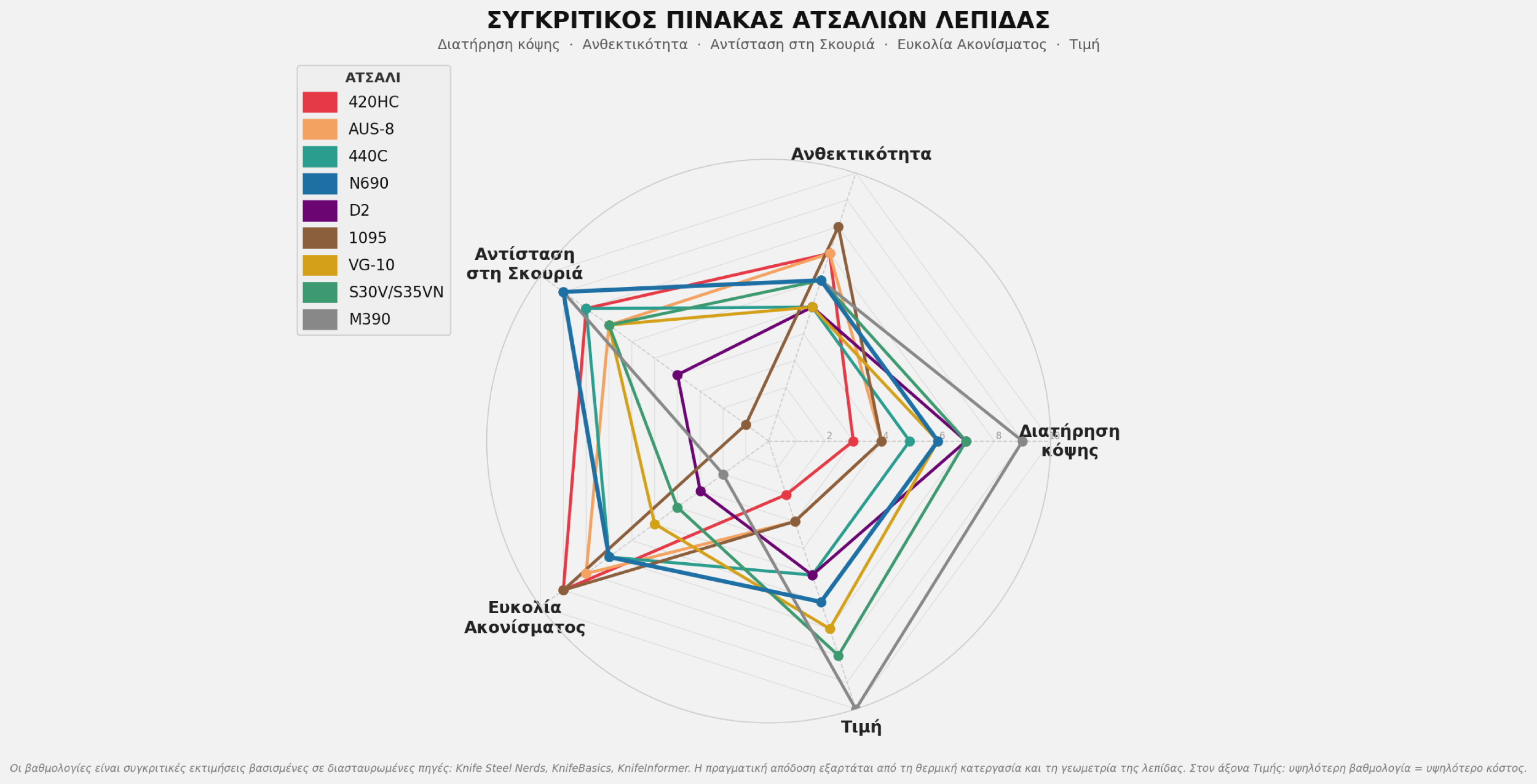
Comparison Table
TYPE | Hardness | Edge Retention | Toughness | Corrosion Resistance | Sharpening | Price |
|---|---|---|---|---|---|---|
420HC | 55–57 | Low | Good | Very good | Very easy | Low |
AUS-8 | 57–59 | Moderate | Good | Good | Easy | Low–Moderate |
440C | 57–60 | Moderate–Good | Moderate | Excellent | Easy | Waist |
N690 | 57–62 | Good | Good | Excellent | Easy | Moderate–High |
D2 | 58–62 | Very good | Moderate | Moderate | Hard | Waist |
1095 | 56–58 | Moderate | Excellent | Low | Very easy | Low–Moderate |
VG-10 | 60–62 | Good–Very good | Moderate | Good | Moderate | Moderate–High |
S30V/S35VN | 59–61 | Very good | Good | Good | Hard | High |
M390 | 60–62 | Excellent | Good | Excellent | Very hard | Very high |
Which One to Choose
If budget is your main priority: AUS-8. Solid performance for the money, reliable.
If you want a dependable all-rounder without spending a fortune: N690. Outstanding balance across all specs, field-proven in professional setups.
If you need maximum wear resistance and edge retention: D2 (if rust isn't a concern) or S35VN (if you also want stainless).
If you're in wet or marine environments: N690 or 440C. Both feature high chromium content.
If you want something easy to sharpen in the field with basic gear: 1095 (if you don't mind the upkeep) or AUS-8.
If budget is no issue and you want the absolute best: M390 or S35VN.
The Bottom Line
There is no single "best" steel — there is only the right steel for your specific use. An N690 in the hands of someone who maintains and sharpens it properly beats an M390 that's neglected. The maker's heat treatment and the blade geometry matter just as much as the alloy itself.
The key takeaway: a solid mid-range steel from a reputable manufacturer will serve you far better than premium steel on a poorly made knife.
At Adventure Gear you'll find a curated selection of fixed blade knives and pocket knives in various steels from trusted European and international makers.